
Egg Fertility Preservation 101
Fertility preservation protects your reproductive tissues so you can have a child in the future. It is usually a consideration for adults and even some youth, especially those who are consider gender affirming treatments.
Do gender affirming treatments affect fertility?
Gender-affirming hormones and some surgeries can alter a person’s ability to become pregnant and to have a child form their eggs and DNA. Testosterone, in particular, creates significant changes in the human body, including stopping menstrual cycles and sometimes egg production. Limited research suggests that these functions can be reversed, but there is no guarantee. Saving eggs prior to treatment is an option.
It is important to recognize that just because menstrual cycles may stop on testosterone does not mean that you are not ovulating (releasing eggs) and could still become pregnant unexpectedly. If you are on testosterone and you have having sexual relationships that could result in an unwanted pregnancy, then please speak to your provider about birth control options including Plan B.
How are eggs preserved?
The most common method of egg preservation is extraction and freezing (cryopreserve). Essentially you receive treatment with hormones (including estrogen) to stimulate egg production in your ovaries. You’ll inject yourself with these hormones daily for about 10 days, and may have to do this multiple times to get a sufficient sample of eggs.
Your provider removes the eggs and freezes and stores them. Egg removal requires the provider to use special instruments and ultrasound to draw up eggs. Since this can be very uncomfortable, it is performed while you’re under sedation — a type of anesthesia where you are lightly asleep. You shouldn’t feel any pain or discomfort during the procedure, but some people feel bloating or discomfort during the days leading up to the procedure and for several days after it.
The collected eggs are then directly frozen under very cold temperatures that preserves them
What if I have already started testosterone?
If you have already started a gender affirming hormones (testosterone), temporary stopping them is necessary to allow re-development of eggs in the ovaries. Stopping testosterone can cause a reversal of some effects as well as the return of regular menstrual cycles, which typically indicates that the ovaries have returned to normal function. Fertility is likely to be restored if testosterone is ceased, but it can take many months and again it is not guaranteed.
How old do I have to be to freeze eggs, and how long do they last?
Eggs can be obtained once a person has had their first period (menses). Periods often starts between nine and 13 years of age (when puberty blockers or testosterone are not used). Unfortunately, breast development has already started at that point, so waiting to start any gender affirming treatment until one can preserve fertility can come with a cost.
If you have started puberty blockers before your first period, then you can come off the blockers to allow for more development to a point where eggs can be obtained. If you have been on testosterone, then you can stop at any time until you have periods and eggs can be obtained. Because female fertility, egg quantity, and egg quality all diminishes with age, the younger you are when preserving your fertility, the better the chance of a successful pregnancy in the future. Doing it when you are younger is also important because the consequences of long-term testosterone treatment on fertility is mostly unknown.
There is no limit to the length of time eggs can be frozen. Once frozen, eggs remain stable indefinitely with no decrease in quality over time.
What is mental health or social support important in the process?
Mental health support is essential during the egg freezing process. The typically mild side effects of the hormones used in obtaining eggs includes breast tenderness, bloating, and a feeling of fullness in the ovaries. This may be especially uncomfortable or emotionally painful for transgender and gender diverse people.
If I later want to start a family, how can I use my eggs?
Transgender and gender diverse people who have a uterus can (and have) carried pregnancies, and can use their own eggs to achieve a healthy pregnancy. Research has demonstrated testosterone can be damaging to a growing fetus so people carrying a pregnancy are advised to stop hormone therapy until they have the baby.
On the other hand, many don’t want to carry a pregnancy, or may choose a hysterectomy (surgery to remove the uterus) as part of their affirmation path. Frozen eggs can be fertilized with a donated sperm and implanted into an agreeing gestational carrier (surrogate) or a partner who has a uterus to carry and birth their genetic child.
How much does it cost and does insurance cover egg freezing?
Egg freezing can be very expensive. A single cycle of medications and collection of eggs can average anywhere from $6,000 to $20,000. That doesn’t include the $500 to $600 yearly storage free. Most employers and insurance companies don’t cover egg freezing. However, even in cases where the procedure isn’t covered, the medications, labs, and other aspects of the process may be (even if medications are covered, that could save you $2,000–$5,000 per cycle).
Are there other options?
There are some experimental procedures where instead of going through hormone treatments to restart periods and obtaining eggs, ovarian tissue is obtained. In some situations, the tissue is moved to your abdomen for later egg extraction, and in other situations, it may be frozen for later reimplantation and egg extraction. These procedures are expense, experimental, and there is no guarantee that it will be successful.
Information Taken from https://fertility.womenandinfants.org/ and https://extendfertility.com/egg-freezing-for-transgender-men/
Options for Preserving Eggs
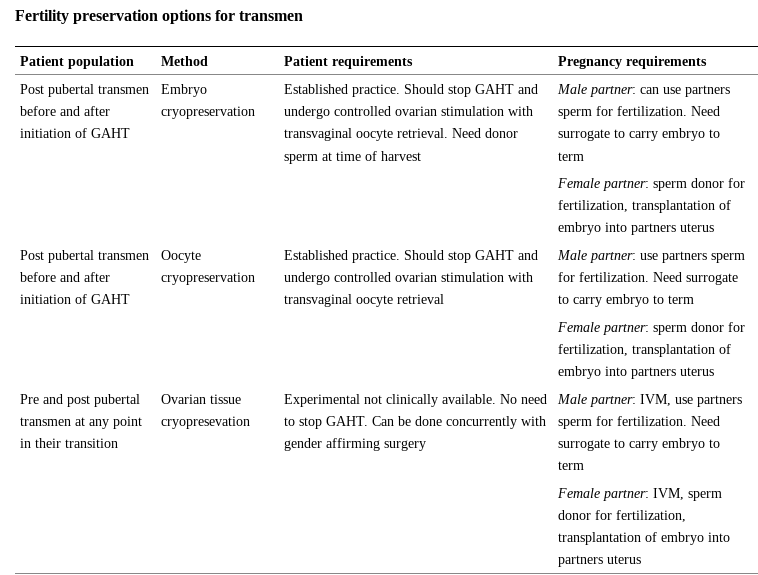
The following table is taken from a systemic review article conducted by Translational Andrology and Urology in 2020. It includes fertility preservation options for individuals with eggs, including experimental options that may or may not be available at this time. Similar information can be found in this Mayo Clinic article.
What is it like?
This article describes some experiences shared by gender diverse individuals who have experiences egg preservation.
Where can I get egg banking done?
| Women & Infants LGBTQIA+ Obstetric & Gynecologic Health Providence, RI Phone: 401-430-8380 Embryo freezing, LGBTQIA+ family building (sperm/egg donation, surrogacy, etc) |
| Fertility Solutions Providence, RI & multiple MA locations 781-423-3956 Services at Providence, RI Fertility Clinic: Ultrasound monitoring, IUI and consultation regarding IVF treatment, ICSI, PGD, egg donation, gestational surrogacy, fertility preservation and much more. |
| Boston IVF (list of MA locations) The Providence Fertility Center Providence, RI 401-369-7822 or patient liaison Rhonda 888-300-2483 or schedule online Has had some success with getting insurance to cover fertility preservation |
| Fertility Centers of New England Multiple locations in MA 877-326-3483 |
| Brigham & Women’s Hospital (in partnership with Boston Children’s Hospital) Boston, MA as well as satellite locations 617-732-4222, option 1 |
 Queer RI